Effect of Temperature in Concreting: Why It Matters in Construction
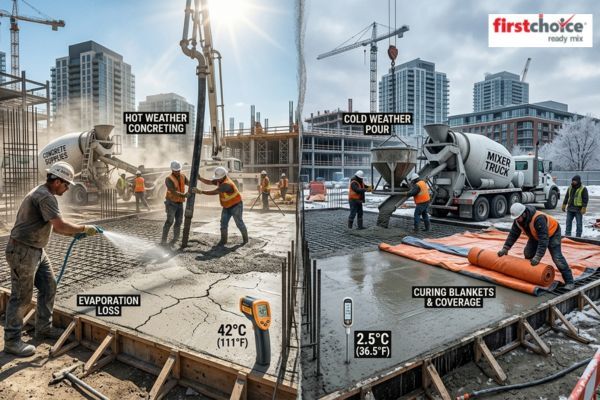
Temperature has a significant effect on concrete performance during mixing, pouring, curing, and hardening. Extreme temperatures and mass pours can cause changes to concrete’s strength, durability, and workability. Today, high-quality readymix concrete can help to ensure consistent concrete and reduce the chances of temperature-related problems at the jobsite.
Temperature control will help ensure that the concrete gets the required amount of strength and does not crack or shrink while still maintaining its durability. The knowledge that you have of hot weather concrete, cold weather concrete, and mass concrete is also key for constructing structures that will last.
Hot Weather Concreting
Concreting in high heat is defined as the process of laying concrete successfully at above average temperature, with the use of wind, low humidity, direct sunlight, etc. These conditions increase evaporation from the surface of fresh concrete and accelerate cement hydration; thus causing concrete to set up at a faster rate than under normal conditions.
Challenges in Hot Weather Concreting
High temperature conditions create challenges when placing fresh concrete:
- Surface water quickly evaporates from the concrete surface
- Concrete quickly loses workability before finishing
- The concrete will set up faster, reducing time available for finishing
- Shrinkage cracks may develop
- Long-term strength and durability may be reduced.
As exposure to high temperatures increases evaporation of water from the surface of the concrete, there is an increased potential for development of plastic shrinkage cracking because the surface of the concrete has lost enough moisture before the concrete has gained sufficient strength.
Preventive Measures
To prevent problems when placing readymix concrete at high temperatures, you should:
- Use chilled water or ice in the mixture
- Schedule pouring in the early morning or late evening hours
- Cover aggregate materials to protect from direct sunlight
- Use retarders or other suitable admixtures
- Cure the concrete properly immediately after placement.
Readymix concrete suppliers often develop specially designed ready-mixed concrete mixtures that maintain workability and structural performance at elevated temperatures for smooth placement.
Cold Weather Concreting
When temperatures dip down below 4-5 degrees Celsius for an extended period of time that is considered cold weather concreting. Low temperatures will slow down the hydration process which can contribute to a delay in the strength of the concrete.
Challenges in Colder Weather Concreting
- Concrete sets much slower than in warmer temperatures
- Delayed addition of strength in the concrete
- Water in the mix can freeze
- The expansion of frozen water can lead to internal cracks in the cured product
- Surface scaling and overall durability issues can arise
If fresh concrete freezes prior to obtaining sufficient compressive strength then the final structure may have lost a significant portion of its design strength.
Preventive Measures
- Use heated water and warm aggregates
- Use accelerators in the concrete mix
- Protect the surface with thermal blankets
- Do not place concrete on frozen ground
- Maintain curing temperatures above freezing
In order to guarantee safe curing environments, construction professionals will monitor both the air and concrete temperature separately.
Mass Concreting and Temperature Control
The process of mass concrete involves large amounts of poured concrete into buildings like dams, bridges, raft foundations, and retaining walls. Heat generated during the hydration of the cement is a large concern for mass concrete projects.
While hydrating a mass concrete structure, the internal temperature of the concrete continues to rise due to the heat generated from the hydration of the cement. The concrete, after significant time has passed since it was placed, will still be generating heat in the centre of the mass while the outer surface of the concrete will have cooled faster than the centre. This temperature difference will create thermal stresses which will cause cracking.
Thermal Cracking
Inadequate temperature control in mass concrete can result in:
- Cracking due to thermal expansion
- Poor development of strength of mass concrete
- Decreased life expectancy and performance of mass concrete
- High internal stresses in the mass concrete core
If not treated sufficiently, cracking may compromise the lifespan and safety of large buildings.
Methods of Thermal Cracking Control
To maintain the uniformity and stability of a mass concrete project, you can:
- Use low-heat cement
- Reduce the amount of cement when possible
- Use tubing or pipe cooling coils inside the mass concrete
- Place mass concrete monolithically
- Continuously monitor both internal and external temperatures
The use of premium grade readymix concrete will help provide a better quality product that offers greater consistency and controlled hydration in mass concrete pours.
Importance of Proper Curing in Temperature Controlled Concreting
In the context of ensuring the quality and performance of concrete, curing is critical when dealing with temperature extremes. Good curing will allow the concrete to retain sufficient moisture to adequately hydrate the cement, which ultimately affects how well the final structure performs.
When concrete is placed during hot weather, improper curing can cause moisture to evaporate too quickly, which can lead to surface cracks, low strength, and poor durability. As such, continuous water curing, curing compounds and/or wet coverings are typically the methods of choice for preventing the premature drying out of readymix concrete.
During cold weather, poor curing can also lead to problems, as low temperatures slow down the hydration of the cement. Therefore, it is critical that the concrete be protected from freezing until adequate strength has developed. Thermal blankets, insulated formwork and controlled heating methods are typically used to maintain proper curing temperature.
In the case of mass concreting projects, proper curing can help reduce the temperature differential between the concrete's core and exterior. The reduction of this differential will minimize thermal stresses and help prevent large structural cracking.
The benefits of proper curing include:
- Increased compressive strength
- Increased durability and service life
- Decreased shrinkage and cracking
- Increased resistance to weathering and chemicals
- Enhanced surface quality and finish
Regardless of the weather conditions, proper curing of readymix concrete is critical to achieving its full potential in modern construction projects.
Conclusion
The temperature affects both durability and quality of concrete for all types of construction projects. Hot weather causes concrete to set too quickly and increases the chances of cracking. In cold weather, hydration occurs much slower than normal, which weakens the development of early strength. Mass concrete placed in large structures has the potential to experience severe thermal stresses between the inside and outside of those structures due to differences in temperature.
With proper planning and curing techniques in place and utilizing quality readymix concrete, construction professionals can overcome these challenges by applying best practices for temperature management to achieve strong, safe and long-lasting concrete structures regardless of the weather!